“Ivory Skin & Black Lace” 12×12″ oil on panel. Thanks to La Esmeralda Stock on dA for the reference photo I used as inspiration!
My latest effort. This was done on the “Artist” panel by Ampersand. A good panel, classified as “budget,” but also still archival. I have a lot of these panels. It has a dovetail slot in the back, so it can be hung as-is on the wall, or slapped in a frame. I love the dovetail slot feature, which is why I’ve stockpiled a lot of these boards. They are about 3/8″ to 1/2″ thick (I think 3/8″) and the sides of the panel are painted a complementary color, so if they are hung unframed, the edges of the board look finished (somewhat reminiscent of “gallery wrap” canvases, which can also be left unframed).
I enjoyed this painting and think the model is very striking. She’s great fun to paint. So dramatic! Her skin is so pale and light, I confess I had trouble capturing that adequately with my color mixing. I think I made her a bit more “pink” than she was in the reference photo, but hopefully she’s not too ruddy or flushed. (All monitors are calibrated differently, but on my computer display, she doesn’t look too red-skinned.)
“Splotchy Kitty Head” 5×5″ oil on Gessobord. Thanks to Nikkayla on DeviantArt for the stock photo I used as reference!
Another month, and some new works! Yes, there has been a lapse of paintings for this blog. It was a busy few weeks. But I’ve still been hard at work, painting!
This cat head painting was a particular challenge, because of all the . . . splotches. Our family calls calico/tortoiseshell kitties “splotched” kitties, because of all the multitude of colors. Well, actually my dad called these type of cats “multi-color.” We can’t just call them “calicos,” now can we? 😉
The challenge in this painting was representing the splotches on the surface of the cat, while still representing the form and dimension. I hope I succeeded in that. It certainly did make me think, as I painted!
In addition, here’s a work in progress painting. Hopefully it’ll be done in a day or two. Not much to say yet about this one, other than I’ve enjoyed the drama drama drama of the pose!
WORK IN PROGRESS. “Ivory Skin 2″ (temporary title), 12×12” oil on panel. Thanks to La Esmaralda Stock of DeviantArt for the reference photo used as inspiration.
This is a bit of an experiment, something I’ve been meaning to do for a while.
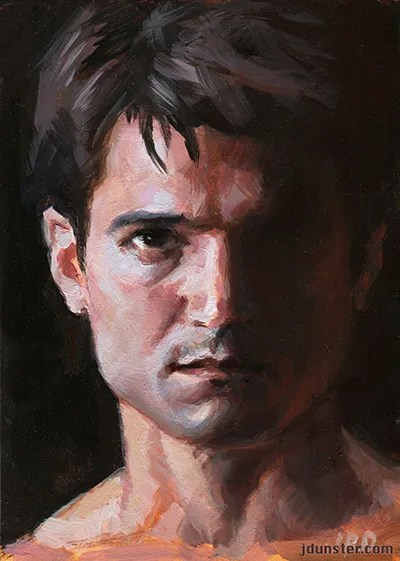
I didn’t use a model or a reference photo for this painting, but instead made it up completely from my imagination. While this portrait is not that unique (I make up faces all the time, for fun), it’s not typical for me to do what I did with the color on this one. Instead of simply inventing the flesh tones, the lights, darks, pinks, greens, warms, cools, I consulted a photo (with a different pose, with a different person) just to “get” the color. Not sure I was completely successful, but I think it’s a worthy exercise and made me really think.
After studying with Adam Clague, I am taught to look for the warms and cools on an object, as well as value, and what color is it (blue? green? magenta? orange?). One of the “rules” is that if you have cool lights, you have warm shadow. If you have warm lights, you have cool shadows.
I applied this rule (as best as I could) and so this portrait has cool lights (flesh tones with a more magenta tint are “cooler” than flesh tones with a yellowish tint) and warm shadows (I used a lot of Transparent Red Oxide in the shadows). While this portrait is just getting me started, it was gratifying and fun to do it.
The title “Pretty Boy” refers to my penchant to draw pretty people when I am inventing faces. I guess this harks back to my childhood, and all the handsome TV heros I grew up with, and sketched in my sketchbook.
EDIT: Ah, such is the life of an artist. A crazy, crazy artist. I pulled an “all-nighter” in my studio and tweaked this painting. And tweaked it. (And constantly updated this page with a picture of each new tweak.) I’m not saying it’s better or worse now, just “different.” Oh boy.
“Orange Kitty Head,” 5×5″ oil on textured panel. Thanks to Lumibear on dA for the stock photo used as inspiration!
Another cat head! A supremely orange kitty! Look at those blue eyes. Orange cats are so fun to paint. I love their coloring. Alas, this is not a portrait of my kitty, since my orange kitties (embarrassed to admit that I must use the plural of “orange kitty”) are grumpy or too pale. Oh, who am I kidding? I will paint my own orange kitties in due time. They must earn their keep, right?
This kitty is a mighty fine orange kitty, with beautiful markings and vibrant color. A joy to paint.
This is a 5×5″ oil sketch done on a nice type of textured gessoed panel. It has a “canvas-esque” type texture, but is just gesso (acrylic ground). The panel is thick-ish (I believe 3/8″ thick) with a dovetail slot in the back (which means you can hang it as-is, or you can stick it in a frame).
“Lady with Hat,” 6×8″ oil on Gessobord. Thanks to swiftsugar of DeviantArt for the stock photo I used as inspiration!
I loved the expression and pose of this one. The original photo that I used as reference had an exaggerated “golden” tint to it, which I didn’t want to paint. So I ran the photo through my iPad photo editing app (not iPhoto) and chose an option that took away a lot of the yellow. Then I used the adjusted photo as my reference. It was an interesting little iPad tweak!
There were a lot of golds, greens, and muted oranges in this one. A different color scheme, but a lot of fun to paint! She has a very vintage look to her, her expression and the way her head is tilted.
I enjoyed painting this one, and now it’s time for the next!
“Jason in Shadow” 5×7″ oil on Gessobord. Thanks to Jason Aaron Baca (model) and Portia Shao (photographer) for the stock photo I used as reference.
I classify this as oils, but to be more specific, I used fast-drying oils (alkyds) on this painting. They are one particular flavor of oils and have been around for a while. (Read more rambling from me about them on this post.)
I’m a big fan of Jason Aaron Baca’s stock photos on DeviantArt. So much drama! Dramatic poses, dramatic lighting, what’s not to love? So here’s another little oil sketch based on one of his photos.
With this painting I was working again with trying to capture the light and shadow, and of great interest to me, the warms and cools. He had a lot of cool tones in the highlighted parts of his face. I’m also working on making more pronounced brushstrokes, more strong and visible. I love bold brushwork and want to get more proficient with that! So exciting!
So, another one done. Put a fork in it! Now onto the next oil sketch. I have several in the works!
I forgot to post this painting earlier. It was completed in August. I loved the intense look on the model’s face, but when I compare my finished piece with the stock photo used as reference, I realize that it ended up being more “inspiration” than a literal reference. I changed the expression, the intensity, the contrast, a lot of things. Now don’t get me wrong, it’s still obviously painted from that particular photo, but the jawline, the shape of the head, and the tilt of the head, among other things, were all changed. I don’t consider it a good likeness of the model anymore. But I have no intention of changing it.
What attracted me to this particular stock photo was the expression of the model, as well as all the variety of colors in his face—the pinks, neutral greens, and even some pale lavenders. It was a challenge trying to capture all of that in the painting. Not sure I succeeded completely, but I tried!
I used Ampersand Gessobord this time, which has a luscious, smooth, eggshell-like surface. I love it. I don’t always want to paint on that type of surface, but it is one of my favorites. It works especially well with smaller works.
I have an explanation for such a long absence from this blog—an arm injury, from a fall I had when I was schlepping art supplies from my old studio to my new studio. Fortunately the injury was not as bad as it could have been (dislocated elbow that “popped” back into place, so it’s “only” a sprain), but boy does it hurt! I am taking it easy for a while. And as a result, I’m mind-numbingly bored.
So, since my activity is limited, I decided to order Eric Rhoads’ “Art Marketing Boot Camp.” Well, to be fair I already had the first DVD of his 3-DVD series, but I got the second DVD while I was pampering my lame arm. What better way to use my time?
I first heard about these DVDs from one of my Facebook acquaintances (Lori Putnam), who gave a glowing review. She attended the first Bootcamp seminar (in 2012) and followed the advice offered to the letter. Her career skyrocketed within a year! Rhoads is well-known in art circles, has a popular blog on marketing, runs some extremely successful art magazines, and so I think he’s got a lot of credibility. Here’s my take on the DVDs.
ART MARKETING BOOT CAMP DVD (I and II) REVIEW!
Screenshot from “Art Marketing Boot Camp” with Eric Rhoads.
OVERVIEW: While these DVDs are pricey, I think they have value and I do recommend them. The lectures are engrossing and very timely.
“Art Marketing Boot Camp DVD One” covers many valuable basics, advises artists to consider what they want, what they are willing to do and what they’re aren’t. Most importantly, he encourages artists to believe that they can make a living from art—the “Starving Artist” story we all grew up with can be a myth. But we must market ourselves! This doesn’t come easy for artists, as our natural inclination is to do the work and expect buyers to magically materialize. But that’s not how it works in the real world.
The first DVD in the Bootcamp series is on one disk, and is almost 4-1/2 hours in length. There are three sections to the DVD, the first section a little over an hour long, the second section (“session”) is a little under an hour, and the third session is 2 hours and 21 minutes.
The DVD was filmed at a Plein Air convention in 2012, with speaker Eric Rhoads lecturing. He shows PowerPoint-type pictures and slides to illustrate his points. He’s a good speaker and very articulate and affable. Occasionally the video cuts away from the Plein Air convention and we are shown Rhoads talking, adding extra information or clarification, while speaking in front of a white screen. (See screenshot above.)
Powerpoint-like graphic from the “Art Marketing Boot Camp” DVD.
The DVD picture and sound quality seems good. The aspect ratio of the DVD is 4:3 (“Fullscreen”) which means you’ll have black bars on the right and left side of your widescreen TV or computer monitor. (I’m not complaining, I’m just explaining!)
I highly recommend this DVD, if you can afford it. It’s full of specific and timely information, and I believe Rhoads when he says that if you follow even a fraction of his guidelines or advice, your art sales will increase.
“Art Marketing Boot Camp DVD Two” is on two disks, and is also around 4-1/2 hours in length. The first disk of the set has two “sessions.” The first session (“How to Build a Brand”) is 1:40 hours. The second session (“Web and Social Media”) is 1:08 hours.
The second disk in the set has one session, “Landing Galleries,” and it’s 1:36 hours in length.
Unlike the first DVD in the series, this DVD was shot in widescreen (16:9), so you won’t get the black bars anywhere on your widescreen TV.
Widescreen DVD screenshot from “Boot Camp” DVD 2
A lot of the second Boot Camp DVD is filmed in a studio (with white background) instead of at the Plein Air convention, but plenty of footage is from the 2013 convention as well.
In this second DVD in the series, Rhoads brings in guest speakers, which were a welcome addition. Don’t get me wrong, I thought everything Rhoads had to offer was fantastic, but added variety is always helpful.
I’ll be honest, I haven’t finished watching the last session (about galleries) but I really enjoyed his lecture about branding as well as social media and the web. One thing that did cross my mind was, that the social media/Internet info has a limited shelf life, so while I still think it’s relevant (as it was only filmed in 2013—a year ago as I type this), there’s going to come a point when the Internet info will become stale.
Some guest speakers wait to give their presentations at the Plein Air convention.
The price of these DVDs are a bit steep, but I viewed the expense as an investment in my future. I’m going to try to take the advice seriously and implement as much of it as I can. I encourage other artists to do the same! Order the DVDs here.
Note: It seems clear to me that the publishers of these DVDs take their copyright seriously, so I have no intention of violating their copyright in any way! I show these few screenshots under “fair use.” I don’t intend to share any more content from these DVDs. Buy your own!
Here’s a non-art themed post! I thought I’d post some pretty pictures from some summer road trips I took this year. I went to Colorado, Texas, and Arkansas. (Two different trips.)
Road trips, with the intention of seeing pretty scenery, are a family tradition. I like seeing attractions like Disneyland too (I grew up going to Disneyland at least one or more times a year) but to be honest my favorite thing is to go see beautiful mountains, beaches, and lakes. And take lots of pictures. Maybe do a painting or two. (I had hoped to do some painting this time, but it was not to be! How foolishly optimistic I was to think I’d have time . . .)
On the way to Telluride, Colorado, June 2014.
Some of these photos will make great reference for paintings later, though!
Ouray, Colorado. Pretty tourist town with a stunning view. June, 2014.
We also tried to see some galleries and such in Colorado:
Ceramics exhibit at The Art Center in Grand Junction, Colorado. June, 2014.
We were investigating some spots in Colorado, because we’re talking (just talking, mind!) of moving there eventually. Colorado has some wonderful galleries and resources for artists. I loved The Art Center (not to be confused with Pasadena’s Art Center).
Aromatic trees in Eureka Springs, Arkansas. August, 2014.
In August I went to Texas and Arkansas. What I saw in Texas (I didn’t see much) was mainly a bunch of dead armadillos by the side of the road. I need to explore Texas more at a later time, because it is a great state!
In Arkansas, I wanted to see Crystal Bridges (a fantastic art museum in “Wal-Martville,” aka Bentonville, AR), and then visited the lovely tourist town Eureka Springs (about an hour away from Crystal Bridges). I took a lot of photos inside the museum, which I must transfer to my computer and prepare for publishing online.
Having lived the majority of my life in California, I have been spoiled by the intensely aromatic incense cedar found in the Sierras and other mountainous areas. When you drive up to Yosemite (which I have done countless times, it’s my favorite place!), your nose is suddenly struck with this glorious, pungent “pine” smell. Impossible to miss. I always associate it with the mountains.
So it makes me sad to not experience the same strong smell in Colorado or the forests in Arkansas. BUT—there is still some hope, because occasionally I get a whiff of it. In higher elevations in Colorado (Rocky Mountain National Park), I smelled the glorious pine smell. Not as strong as incense cedar, but unmistakable. And the same wonderful smell could be detected, albeit fleetingly, in Eureka Springs!
I’m going to add a brief entry to my “tutorials” section. It’s not much, but I feel badly that I haven’t been updating the blog as frequently. (It’s summer, what can I say? I went on another road trip last week.)
I’ve dabbled in alkyds (fast-drying oils) for a long time now. I first tried it in art school, many moons ago. I think that at the time we only had Winsor & Newton brand. The first impression I had of alkyds (back then) was that they weren’t as opaque as regular oils, and they had a kind of “waxy” texture. But they were quite workable, and I loved the fast drying time!
“Jason in Shadow,” 5×7″ alkyd on Gessobord. Thanks to Jason Aaron Baca (model) and Portia Shao (photographer) for the use of the stock reference photo.
Here’s an alkyd study I did recently. Now we have several brands of alkyds to choose from, and they don’t seem as “waxy” as they used to, way back. But they are still quick-drying!
I typically use Liquin (an alkyd medium) when I paint in alkyds. This should help speed drying time more. I find that usually in less than a day (depending on the paint thickness) the painting is dry enough, and ready to be worked on again.
Here’s another recent alkyd painting (WORK IN PROGRESS!).
“Blue Hair,” 12×12″ oil (alkyds) on canvas panel. WORK IN PROGRESS!!!! Thanks to Cathleen Tarawhiti on DeviantArt for the stock photo I used as reference.
With “Blue Hair,” the painting was dry to the touch later the same day, so I was able to do some work in the morning/noonish, and do a little more later on in the day. Amazing! I love my alkyds.
Even though we have several brands of alkyds to choose from (as opposed to just W&N’s alkyds, back in the day), I wish there were even more brands and colors available. Winsor & Newton’s “Griffin” brand has recently discontinued all cadmium colors. I understand that they have probably made this decision because cadmiums have some toxicity, but cadmium “hues” aren’t the same—cadmiums have an opacity and denseness that cannot be replicated in “hues.” Fortunately, the other alkyd brands (C.A.S., DaVinci, and Gamblin) do still carry cadmiums.
Each brand of alkyd has their own properties. I think DaVincis tend to be very thick and stiff. (Kind of like Old Holland in that respect.) I will still use them, am very grateful for DaVinci’s line of alkyds, but given a choice, I prefer something a little more buttery. Gamblin’s “FastMatte” alkyds are pretty good, soft and buttery, though I wish they carried more colors. CAS is a good quality brand, but sometimes their customer service sucks if you order from their site. (Long, long story there. For another time!) Griffins have a good consistency and I think a decent pigment load, but I miss the cadmium colors.
Alkyds have, in some form or another, been around for many decades. I’ve heard that studies indicate that they are “stable” and I am comfortable using them. My old paintings done in art school still seem rich and vibrant as ever. As long as we use pigments that are strong and light-fast, I think they’re an awesome alternative to regular oils. In fact, it’s perfectly acceptable to mix alkyds with regular oils. (Many artists use an alkyd white with their regular oils, which tends to speed up drying time on all the paints.) Some manufacturers of regular oils sell a “fast drying” white, which is often made with alkyds, for artists who enjoy the fast-drying properties of alkyds but don’t want to use a whole set of alkyd colors.